
Waterproof Coating Agent
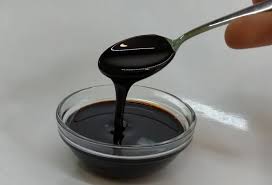
APP + SBS Modified Asphalt Waterproof Coating
High-Polymer (APP + SBS) Modified Asphalt Waterproof Coating (Water-Based) is an environmentally friendly waterproof coating made by water-based modification of asphalt using APP and SBS as modifiers.
The product combines the heat resistance of APP with the flexibility of SBS, forming a dense, resilient waterproof membrane with excellent waterproofing performance, suitable for various building waterproofing projects.
Packaging and Specifications
| Item | Description |
|---|---|
| Physical State | Liquid |
| Color | Purple brown viscous liquid |
| Packaging Form | Plastic drum or iron drum |
| Packaging Specification | 25 kg iron drum or 50 kg plastic drum |
Performance Indicators
| Item | JC/T 480-2005 I-type |
|---|---|
| Solid Content (%) | ≥ 45 |
| Heat Resistance (90°C ± 2°C) | No flowing |
| Sliding or Dripping (90°C ± 2°C) | No flowing, sliding or dripping |
| Bond Strength (MPa) | ≥ 0.30 |
| Surface Drying Time (h) | ≤ 8 |
| Full Curing Time (h) | ≤ 24 |
| Elongation at Break (%) | ≥ 600 |
| Low Temperature Flexibility | -15°C, no cracks or breaks |
| Waterproofing | 0.1 MPa, 30 min, no water penetration |
| VOC Content (g/L) | ≤ 80 |
Packaging and Specifications
| Item | Description |
|---|---|
| Physical State | Liquid |
| Color | Purple brown viscous liquid |
| Packaging Form | Plastic drum or iron drum |
| Packaging Specification | 25 kg iron drum or 50 kg plastic drum |
Performance Indicators
| Item | JC/T 480-2005 I-type |
|---|---|
| Solid Content (%) | ≥ 45 |
| Heat Resistance (90°C ± 2°C) | No flowing |
| Sliding or Dripping (90°C ± 2°C) | No flowing, sliding or dripping |
| Bond Strength (MPa) | ≥ 0.30 |
| Surface Drying Time (h) | ≤ 8 |
| Full Curing Time (h) | ≤ 24 |
| Elongation at Break (%) | ≥ 600 |
| Low Temperature Flexibility | -15°C, no cracks or breaks |
| Waterproofing | 0.1 MPa, 30 min, no water penetration |
| VOC Content (g/L) | ≤ 80 |
Note: All data above were measured under standard test conditions (Temperature: 23°C ± 2°C, Relative Humidity: 60% ± 10%).
Application Scope
Suitable for roof waterproofing in buildings, underground engineering, and indoor waterproofing, as well as renovating waterproofing projects.
Note:
The product can be used for waterproofing both interior and exterior walls.
It does not provide sufficient load-bearing adhesion strength; therefore, tiles, stones, or other heavy objects should not be adhered directly to the waterproof coating on exterior walls.
For interior walls where tiles are installed, the coating height should not exceed 10 cm to prevent tiles or heavy objects from falling and causing safety hazards.

Product Features
Environmental Safety
Water-based solvent, no volatile organic solvents, non-toxic and odorless, safe for humans and the environment, with no hazards during construction.Excellent Waterproofing Performance
Forms a continuous, high-strength waterproof membrane on the substrate surface, effectively resisting penetration by rainwater, groundwater, etc., with long-lasting waterproofing effects.High Adaptability
Possesses excellent flexibility and crack resistance, accommodates minor deformation and movement of the substrate, and exhibits outstanding performance at both high and low temperatures (non-flowing at high temperatures and non-brittle at low temperatures).Convenient Application
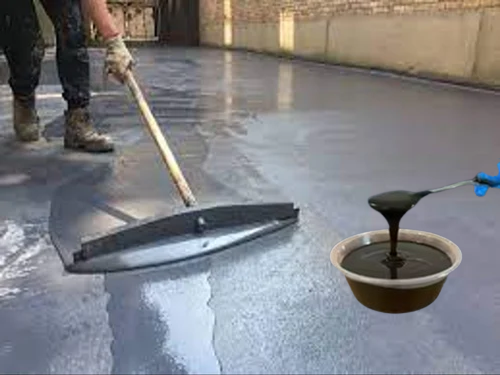
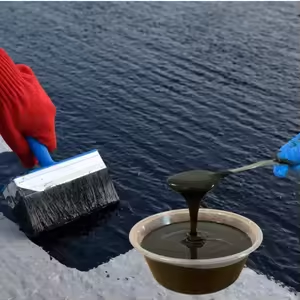
Can be applied using brushing, spraying, or scraping. Simple operation with low technical requirements; dries quickly, reducing construction time.Strong Adhesion
Bonds firmly to various substrate materials such as concrete, cement mortar, and brickwork, and does not peel off easily.
Construction Application
Construction Quantity
When the thickness of the waterproof coating is 1.5–2.0 mm, consumption is approximately 2.5–3.0 kg/m²
(actual consumption depends on substrate flatness).
It is recommended to conduct a test application first.
Construction Process
Substrate preparation → Detail treatment → Waterproof coating application → Quality inspection and acceptance → Protective layer application
Construction Key Points
1. Substrate Preparation
Substrate must be flat, firm, smooth, clean, and free of loose particles, dust, oil stains, hollows, or sanding.
Corners should be rounded (radius ≥ 50 mm) or chamfered.
Pipes and drains must be sealed and even.
Cracks and holes should be repaired with repair mortar or waterproof coating mixed with non-woven fabric.
After substrate repair, apply a primer layer and allow it to dry completely (typically 2–4 hours).
2. Detail Treatment
Corners, pipe roots, floor drains, and other critical areas should be reinforced first.
Apply a layer of coating, embed polyester fiber non-woven fabric or glass fiber mesh cloth, then apply another layer of coating to fully cover the fabric.
Pay attention to overlaps; overlap width should be ≥ 100 mm.
Press firmly with a scraper to ensure tight bonding without bubbles or hollows.
3. Waterproof Layer Construction
Brushing Method
Mix coating thoroughly and apply with a brush.
Each coat should be applied perpendicular to the previous coat.
Thickness per coat: 0.3–0.5 mm.
Interval between coats: 4–6 hours (touch-dry).
Spraying Method
Pour coating into spray equipment; adjust viscosity with appropriate water if needed.
Adjust spray pressure and nozzle diameter.
Apply evenly, controlling spray speed and thickness to avoid sagging or missed areas.
Thickness per coat: 0.3–0.5 mm.
Scraping Method
Apply evenly using a scraper with uniform force to avoid scratches or bubbles.
Thickness per coat: 0.5–1.0 mm.
Apply coats successively until the required thickness is achieved.
4. Protective Layer Construction
After the waterproof coating is completely dry (typically 24–48 hours, depending on temperature and humidity), apply the protective layer promptly.
Protective layers may include cement mortar, fine gravel concrete, reflective coating, or roll materials as per design requirements.
During construction, avoid damaging the waterproof layer.
Transportation and Storage
Store in sealed containers in a cool, well-ventilated area (5–35°C).
Avoid direct sunlight and freezing temperatures.
If stored at low temperatures, take insulation measures to prevent freezing.
Under normal transportation and storage conditions, the shelf life is 12 months.